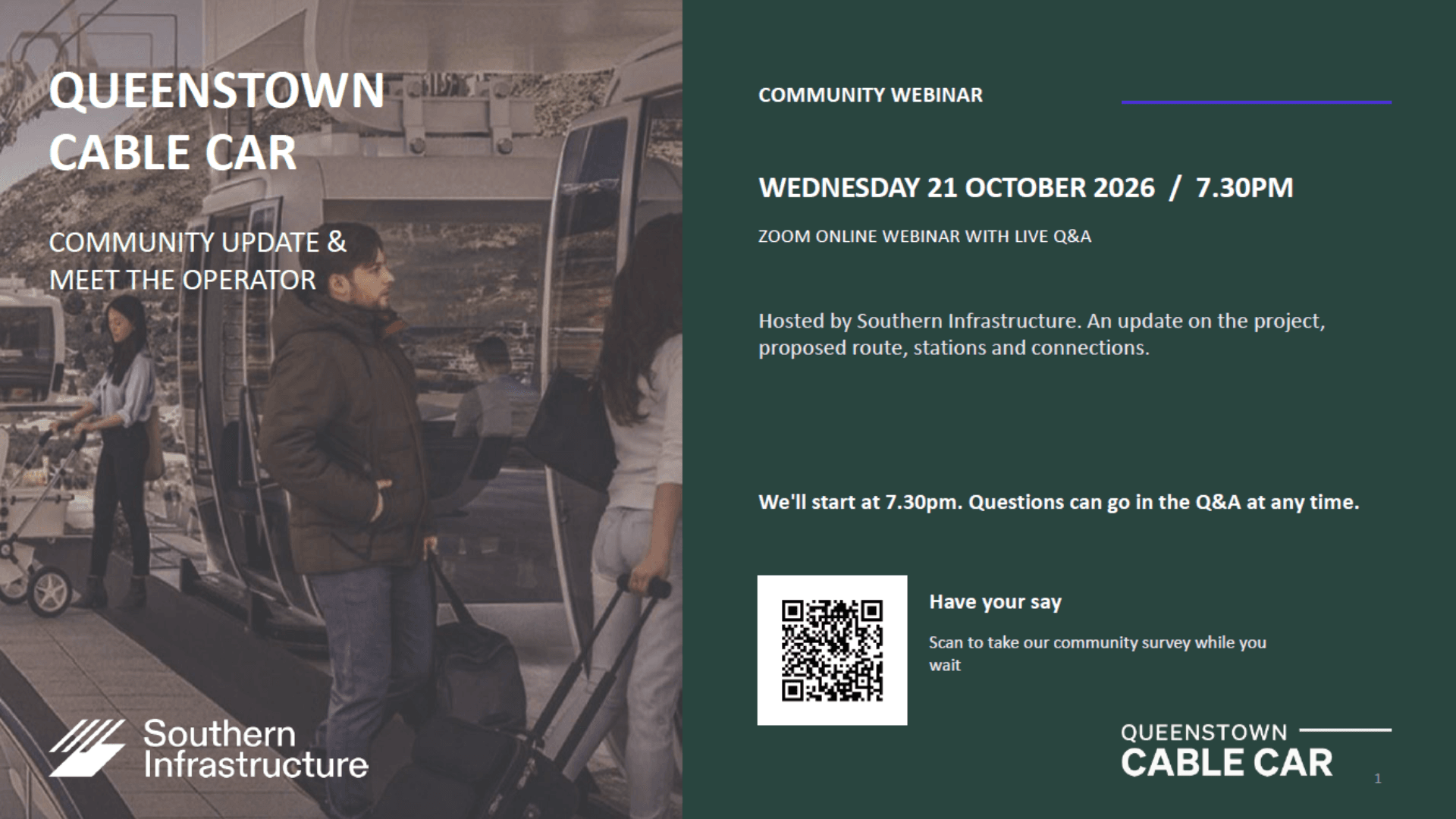
Webinar Summary: Community Webinar Summary - 21 October 2026
Queenstown Cable Car community webinar update
21 October 2026
How long would the journey take, where would you board, and would the service work for your daily commute? Those were some of the questions explored at our community webinar on Wednesday 21 October, as Ross Copland and Queenstown Cable Car Establishment General Manager Toby Arnott shared the latest on the proposed network.
The discussion covered how the cable car could fit into everyday life in Queenstown, alongside an update on design, funding and the decisions still ahead. Community feedback is helping us understand what people would need from the service, including early starts, convenient connections and affordable fares.
More predictable journeys outside road traffic
The proposed journey from Queenstown Airport to the town centre is around 21 minutes, with a journey from Ladies Mile to Queenstown expected to take around 33 minutes. Travelling above the road would mean the cable car journey is unaffected by traffic congestion, making it easier to plan when you need to leave.
These are indicative station-to-station journey times. Your full trip would also include reaching the station, boarding and any onward connection. People travelling from Ladies Mile would change lines at Lake Johnson. The system may run more slowly during quieter periods to reduce operating costs and wear, adding a few minutes to the journey.
Where the stations would be
The network being developed connects Queenstown Airport with the town centre via Frankton, Lake Johnson and Queenstown Hill, with a second line serving Five Mile, Quail Rise, Lower Shotover and Ladies Mile. A point clarified during the webinar was that the airport and Frankton Bus Hub would have separate stations, with another station at Five Mile.
The proposed town centre station would sit beside the recreation ground, combining cable car access with bus connections, passenger pick-up and drop-off and parking. Final station locations and access arrangements remain part of the design and approvals work.
Connecting the whole journey
The cable car is intended to work as part of a connected public transport network, alongside buses, ferries, walking and cycling. Discussions with Otago Regional Council are considering how bus services could connect people with stations and serve areas beyond the cable car route, including communities along Frankton Road.
More than 1,400 parking spaces are proposed across the network at Ladies Mile, the airport and Queenstown, including around 700 at Ladies Mile. EV charging and secure bike storage are also being incorporated into the station designs. Parking is not expected to be free, although combined travel and parking passes and discounted longer-term options are being explored. No dedicated cable car parking is currently proposed at Frankton Bus Hub.
Fares and hours that work for residents
Affordability remains central to the proposal. The team discussed a preferred fare approach of around $5 for local adults and $15 for visiting adults, with visitor fares helping keep everyday travel affordable for residents. These are proposed figures, not confirmed fares. Otago Regional Council would determine final fares and concessions as the public transport authority.
The intention is to use the national Motu Move ticketing system to support connected journeys. Child fares, other concessions, transfer rules and fare caps would depend on the final arrangements.
The default operating scenario modelled is 7 am to 8 pm. Attendees highlighted that some workers need to arrive at work by 7 am and that passengers also need to reach early flights. That feedback is important as operating hours are refined with the wider transport network. Earlier starts and extended hours for special events remain options to consider.
Making boarding and travelling easier
Cabins are designed for up to ten passengers, with level boarding and space for wheelchairs, prams and luggage. Around two bikes per cabin is considered a practical arrangement. Frequent cabins would support a turn-up-and-go service, although boarding space and waiting times would depend on demand and the mix of passengers and equipment.
At the airport, an elevated connection between the terminal and cable car station is being explored, with lifts and escalators where needed. The exact arrangement is still being developed with the airport. CCTV and emergency intercoms are planned in cabins, and boarding assistance forms part of the operating work.
Reliability and future connections
The design work considers local wind conditions, backup power and emergency drives. Solar generation and battery storage are proposed to help manage electricity demand and provide resilience during outages. Safety checks and operating procedures would determine when the system could run following a significant event.
Residents also asked about the Southern Corridor and links to water transport. Southern Corridor options are being considered, but are outside the current two-line proposal and involve additional design challenges. A possible airport-to-waterfront connection has been studied, while a direct line to Queenstown Marina would raise visual and consenting considerations. Neither is a confirmed addition to the network.
The decisions still ahead
Council’s 8 October agreement in principle on reserve land use was a step in the process, rather than permission to build. Further work is under way on alignment, design and land-use terms, including an option that would avoid crossing the Queenstown Events Centre.
Southern Infrastructure is pursuing private finance for construction, while the full funding and operating arrangements remain under development. Private construction finance does not, by itself, settle how finance would be repaid or how ongoing services would be funded.
The team is aiming to lodge its substantive consent application in the first quarter of 2027, with construction targeted for 2028 and opening for 2030. Those dates depend on approvals, land agreements, financing and the remaining design and delivery work.
Keep sharing what would work for you
Thank you to everyone who joined the webinar and contributed questions. Feedback about the journeys you make, the hours you work and the connections you need helps the team refine the proposal. Please share your questions and suggestions with us, or get in touch if your community group would like a briefing. This engagement helps shape the design and is separate from formal participation in the approvals process.